


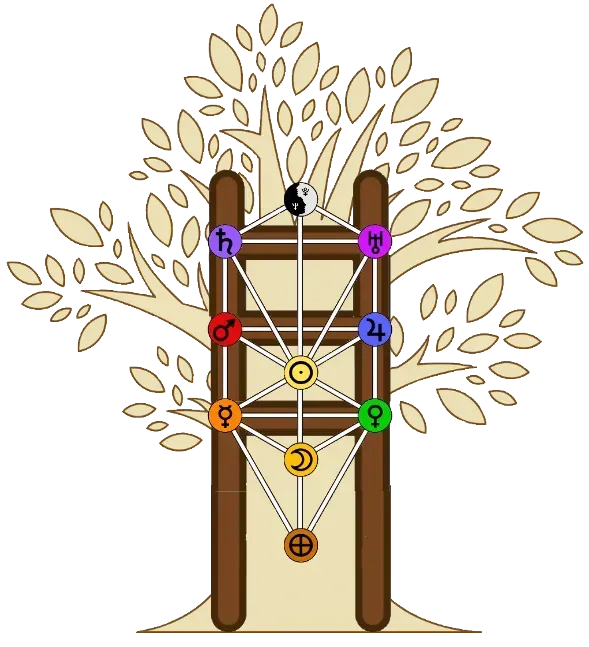
The Tree of Life
“Simo Parpola asserted that the concept of a tree of life with different spheres encompassing aspects of reality traces its origins back to the Neo-Assyrian Empire in the ninth century BCE.” — Wikipedia, “Tree of Life”
The Tree of Life in the above illustration is a diagram of fundamental archetypal energies which has evolved through assorted versions over many centuries. This popular version emerged in the 14th century and has been used in various mystical traditions ever since.
"All the most powerful ideas in history go back to archetypes." — Carl Jung
"There are as many archetypes as there are typical situations in life. Endless repetition has engraved these experiences into our psychic constitution, not in the forms of images filled with content, but at first only as forms without content, representing merely the possibility of a certain type of perception and action." — Carl Jung
Though we usually encounter this diagram in the context of one esoteric tradition or another, the basic pattern of the Tree of Life does not belong to any particular culture. The essence of it transcends cultures and is universal, so that anyone might benefit from contemplating it.
Accordingly, people everywhere seem to agree on the basic functions of the formless energies attributed to the spheres on the Tree. However, the same cannot be said of symbols and forms associated with the sphere energies, and especially with the paths that link them on the Tree. All kinds of additional correspondences have been ‘grafted’ onto the Tree according to the beliefs and teachings of the traditions and individuals using it. Individuals speculate freely about appropriate correspondences to the paths, yielding a variety of theories.
In my view, there is no need for membership in any formal mystical tradition in order to interpret the Tree of Life and find profound meaning in it. To know the planetary energies (which not everyone does) is to know the spheres on the Tree from whence all else on it is derived. Interpretation of any path begins with the combined meanings of the two spheres that it connects. Beyond that, the Zodiac and the tarot give us all the symbolic language we need for a clear and meaningful interpretation of the whole Tree.
This mystical diagram is rich in meaning, not to be understood all at once, but through periodic contemplation, organically. At first one sees distinct archetypes, then connections among them; in time the whole map comes to life in one’s mind, an inner reality to be explored at will as if it were a dream. ‘There’ our intuition lets us discover more of what we already know about life than we ever realized we knew. Not only is it fun, but it offers lasting benefits:
a satisfying orientation to reality so that we never need to feel “lost”
a way of keeping things in perspective no matter what happens, rather than sometimes feeling confused and overwhelmed
The Tree of Life truly is mystical, but not because it’s too esoteric for an ordinary seeker to understand, as some seem to believe. It’s mystical because, with repeated contemplation, it really evokes natural intuition and yields progressively deeper insights into the human life that we all live.
In this series, we view astrology and tarot as elegantly combined to the enhancement of both in the Tree of Life, which is comprised of three parts:
The Colorful Fruits (the spheres)
The Storytelling Serpent (the diagonal paths)
The Ladder to the Stars (the vertical & horizontal paths)
An interpretation of a tarot card belonging to the Ladder is featured each month.
The Colorful Fruits
The ‘fruits’ on the Tree are the 10 spheres. There is general agreement as to their correspondences with the planets and with most of the sphere colors. The outer planets (Uranus, Neptune and Pluto) had not yet been discovered in the 14th century, but the existence of similar energies was intuited, and spheres with descriptions appropriate to those planets were included on the Tree.
Here’s a closer view of the spheres/planetary powers as they appear on the basic Tree:
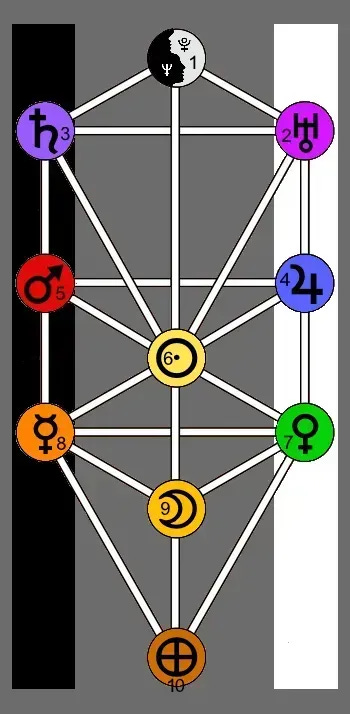
The more powerful collective outer planets correspond to the upper spheres, while the less powerful personal planets correspond to the lower ones, closer to the Earth. Halfway up the Tree are the “social” influences involved in issues of conflict and justice.
The planets/spheres on the Tree are numbered in order of strength from the top down, 1 being the most powerful and 10 being the least. Life manifests through them in sequence from 1 down to 10 (the “Lightning Path”); consciousness then develops more slowly in reverse sequence from 10 up to 1 (the “Serpent Path”).
The 10 planetary influences and their numbers correspond to the numbered cards of the Minor Arcana in the tarot, which portray examples of their effects.
The positions of the spheres on the Tree tell us more about the relationships of the ten energies to one another. Overall, Saturn, Mars, and Mercury are said to comprise energies oriented to the challenges of physical life on the black “Pillar of Severity”, while Uranus, Jupiter, and Venus encourage expansion of experience through opportunities and rewards on the white “Pillar of Mercy”. The general effect is that of “bad cop/good cop”.
On the “Middle Pillar” between the two, human consciousness learns to keep the Black and White extremes in balance, neither too “severe” and controlling nor too “merciful” and lax, in order to live wisely and well.
As it develops, consciousness ‘rises’, or ‘ascends’ up the Center, growing progressively ‘brighter’ through mastery of states marked by the lights of the Earth, the Moon, the Sun, and Neptune/Pluto.
"Colors express the main psychic functions of man." ~ Carl Jung
The planetary spheres on the Tree are the very same energies that are described in the Pantheon of Colors series here at Elixir, listed below with their numbers on the Tree. To read a published post about any planet and the 4 tarot cards associated with it, click on its Pantheon link:
NEPTUNE (Black) = Concealing, Mystery, Imagination, Illusion, Intoxication. Modern ruler of Pisces (and Sagittarius?). Minor Arcana Aces.
PLUTO (White) = Revealing, Penetration, Detoxification. Modern ruler of Scorpio and Aries.
URANUS (Purple) = Creativity, Individuality. Ruler of Aquarius. Minor Arcana Twos.
SATURN (Violet) = Gravity, Contraction, Boundaries, Commitment to Time, Burdens & Delays, Duty, Fate. Ruler of Capricorn. Minor Arcana Threes.
JUPITER (Blue) = Wisdom, Confidence, Humor, Expansion, Lightness. Classic Ruler of Sagittarius and Pisces. Minor Arcana Fours.
MARS (Red) = Desire, Assertiveness, Physical Strength & Speed. Classic ruler of Scorpio and Aries. Minor Arcana Fives.
THE SUN (Yellow) = Ego Awareness, Honor, Balance. Ruler of Leo. Minor Arcana Sixes.
VENUS (Green) = Beauty, Harmony, Aesthetic Sensitivity. Ruler of Taurus and Libra. Minor Arcana Sevens.
MERCURY (Orange) = Knowledge, Efficiency, Attention to Details. Ruler of Gemini and Virgo. Minor Arcana Eights.
THE MOON (Amber) = Feeling, Memory, ‘Programming’, Habit. Ruler of Cancer. Minor Arcana Nines.
THE EARTH (Brown) = Current Established Reality. No rulership. Minor Arcana Tens.


The Storytelling Serpent
“The snake, or serpent, is one of the most symbolically significant animals in literature, religion, and mythology. Although many people associate the snake with sinister and even downright evil connotations, in reality the symbolism of the serpent is far more ambiguous and wide-ranging than this.”
— Dr Oliver Tearle (Loughborough University), “The Curious Symbolism of Snakes in Literature and Myth”
In the context of the Tree of Life, the Serpent is a metaphor for Time and Space.
The ancient symbol of the Ouroboros expresses the cyclical nature of time, as does the Zodiac and Joseph Campbell’s Monomyth (the Hero’s Journey), both of which tell the universal story of human experience and inner development through time.
Below we see the Ouroboros coiled around circular diagrams of the Zodiac and of tarot images associated with the Monomyth. Its rope-like appearance emphasizes our being bound to time and space throughout our lifetime on earth. The place in the cycle where head bites tail is where a life renews itself, taking only unlearned lessons remaining from the old cycle into the new one.


This very same serpent appears unwound as the diagonal paths on the Tree of Life, allowing for further symbolism alluding to the gradual shift of our consciousness towards the timeless Center as we improvise our way spiralwise through our story.
Life is said to manifest, or “emanate”, from the top down in a “Lightning Flash”, while human awareness develops from the bottom up as we ‘climb’ the diagonal segments of the “Serpent Path” through time towards reunion with our Source.
See in the diagram below how the Zodiac unfolds in sequence up the 12 diagonal paths of the Tree. The 6 “feminine” (Earth & Water) signs are all on the left side; the 6 “masculine” (Air & Fire) signs are all on the right. Thus the serpent “slithers” up the Tree in alternating sign genders, a pendulum-like motion that brings progressively difficult “bad cop/good cop” challenges from increasingly powerful archetypes as we climb.
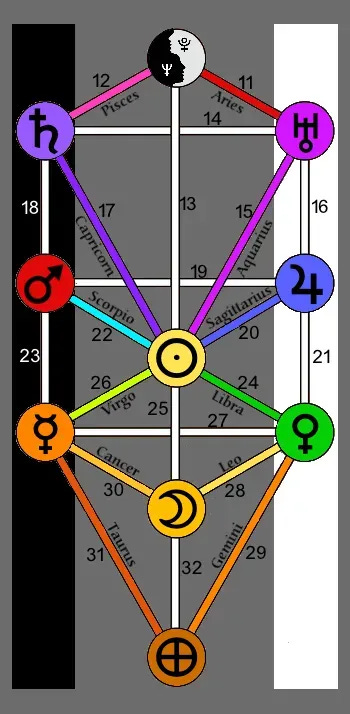
The Quest for the Elixir series tells of the Hero’s Journey we take on the Serpent Path in greater detail.
Each month we celebrate the segment of the Journey corresponding to the current Sun sign. To learn more about (or to review) the part of the story we are celebrating now, find the current Sun sign in the list below and click on its Quest post:
The Path of The Garden = TAURUS = the 31st Path (between the Earth and Mercury). Life emerges from a seed or womb (Earth) to behold
the various details (Mercury) of a new world.

The Path of The Fool = GEMINI = the 29th Path (between the Earth and
Venus). Exploration of the immediate environment.

The Path of The Guardian = CANCER = the 30th Path (between the Moon and Mercury). Prohibitions, fears, and associations with bad memories serve to protect us from danger and trouble.

The Path of The Lovers = LEO = the 28th Path (between the Moon and Venus). Encouragement, hope, and associations with good memories serve as guides to success and fulfillment.


The Path of The World = SAGITTARIUS = the 20th Path (between Jupiter and the Sun)


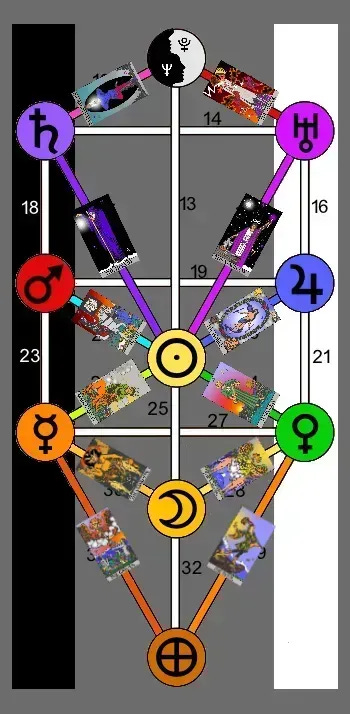
Here’s the way the Major Arcana cards associated with the universal story appear on the diagonal paths of the Tree:
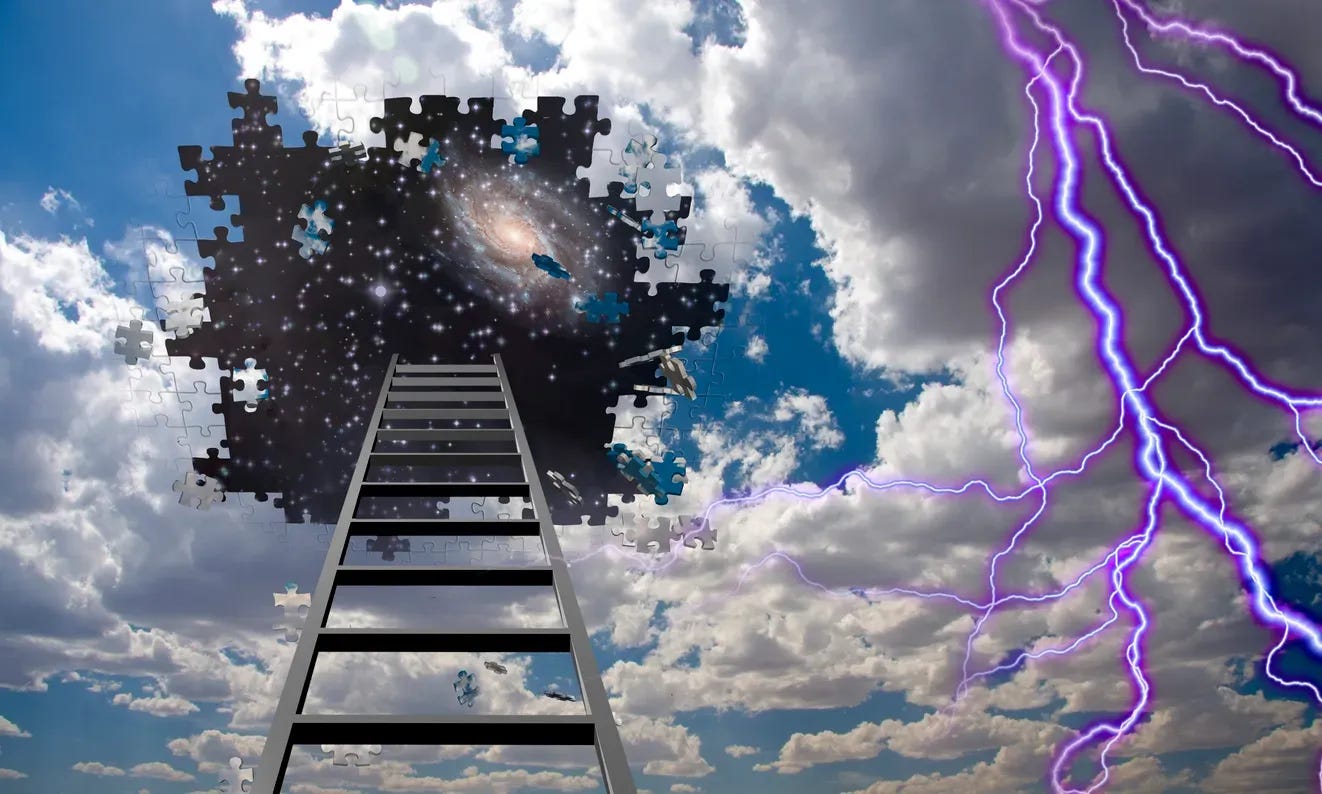
The Ladder to the Stars
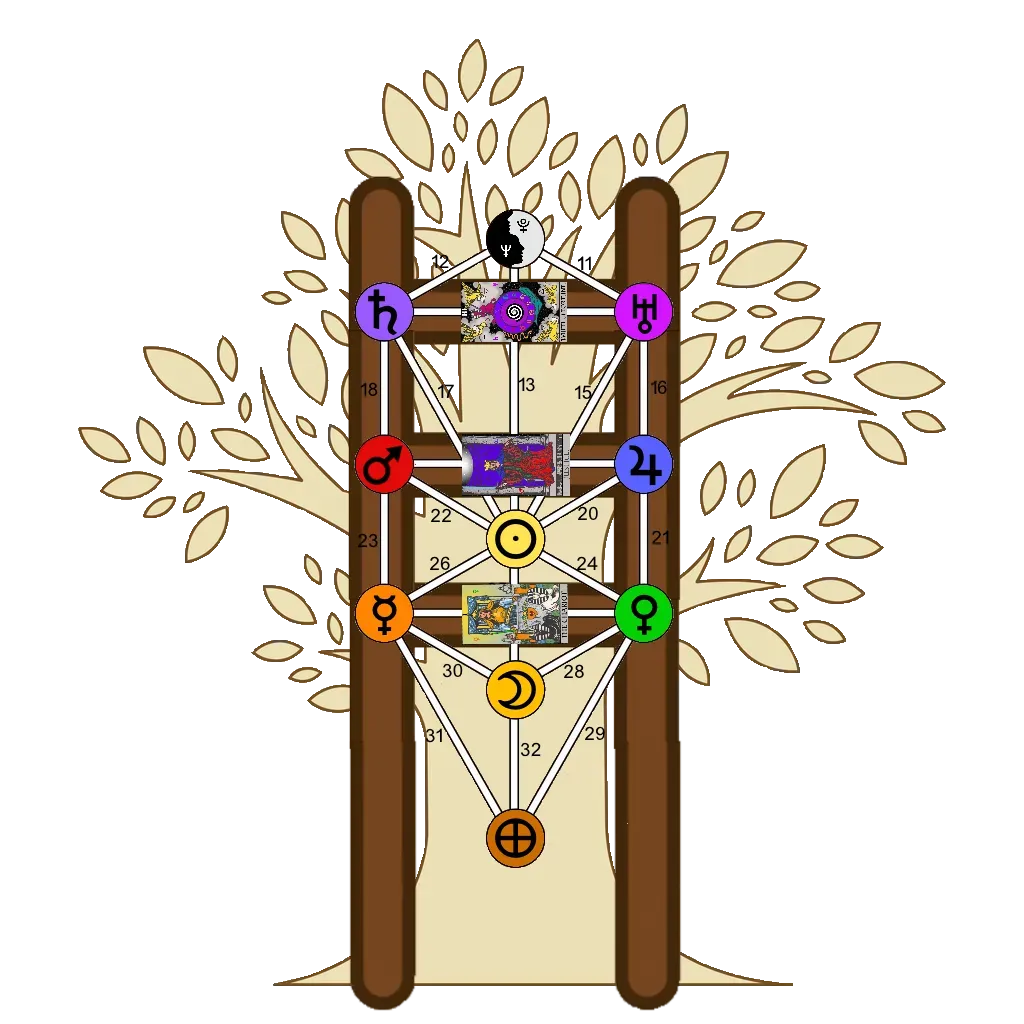
The ladder on each of the Tree images below highlights the 10 vertical and horizontal paths on the Tree of Life. They are not segments of the Hero’s Journey, but rather are ‘signposts’ of inner development along the way up the Tree. 4 of them are associated with influences of the 4 Elements, 3 of them with states of consciousness, and 3 with transitions from one stage of life to another. Like the 12 phases of the Journey, they have correspondences in the Major Arcana of the tarot.
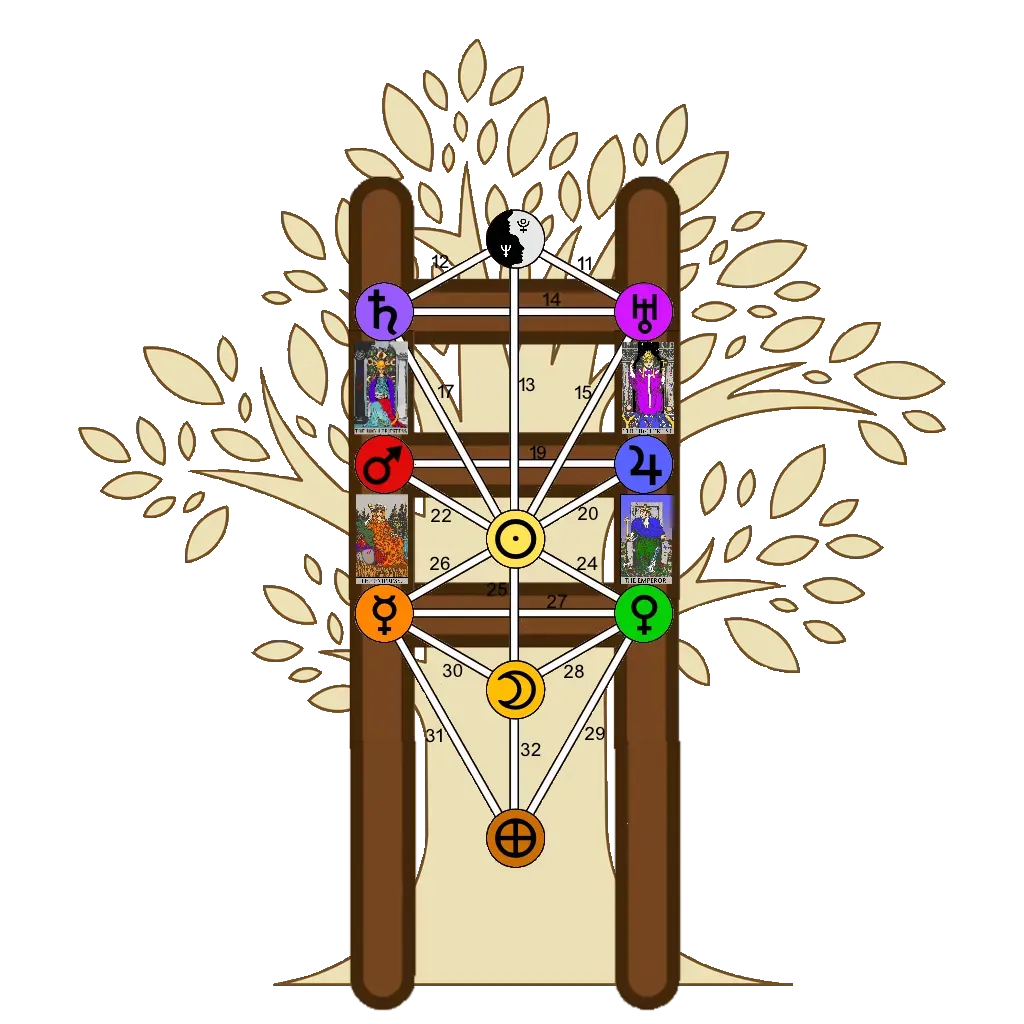
The rails of the ladder are like the black and white pillars mentioned above. On them are the paths related to the 4 Elements.
The Left Rail
This is the “feminine” rail of forms, both imaginary (Water) and physical (Earth).
The Watery Path of The High Priestess is the 18th Path (between Saturn and Mars), The Witch of Fate.
The Earthy Path of The Empress is the 23rd Path (between Mars and Mercury), Mother Nature. Desire for physical life (Mars) connects with the skills needed to raise and maintain it (Mercury).
The Right Rail
This is the “masculine” rail of forces, both spiritual (Fire) and mental (Air).
The Fiery Path of The High Priest is the 16th Path (between Uranus and Jupiter), The Wizard of Free Will.
The Airy Path of The Emperor is the 21st Path (between Jupiter and Venus), Father Culture. Beliefs about life (Jupiter) connect with society and the arts (Venus).
The 3 Rungs
The rungs are all transitions, steps up from one stage of life to another.
The Path of The Chariot is the 27th Path (between Mercury and Venus), Coming of Age.
The Path of Justice is the 19th Path (between Mars and Jupiter), Initiation.
The Path of The Wheel of Fortune is the 14th Path (between Saturn and Uranus), Destiny.
The Ascent
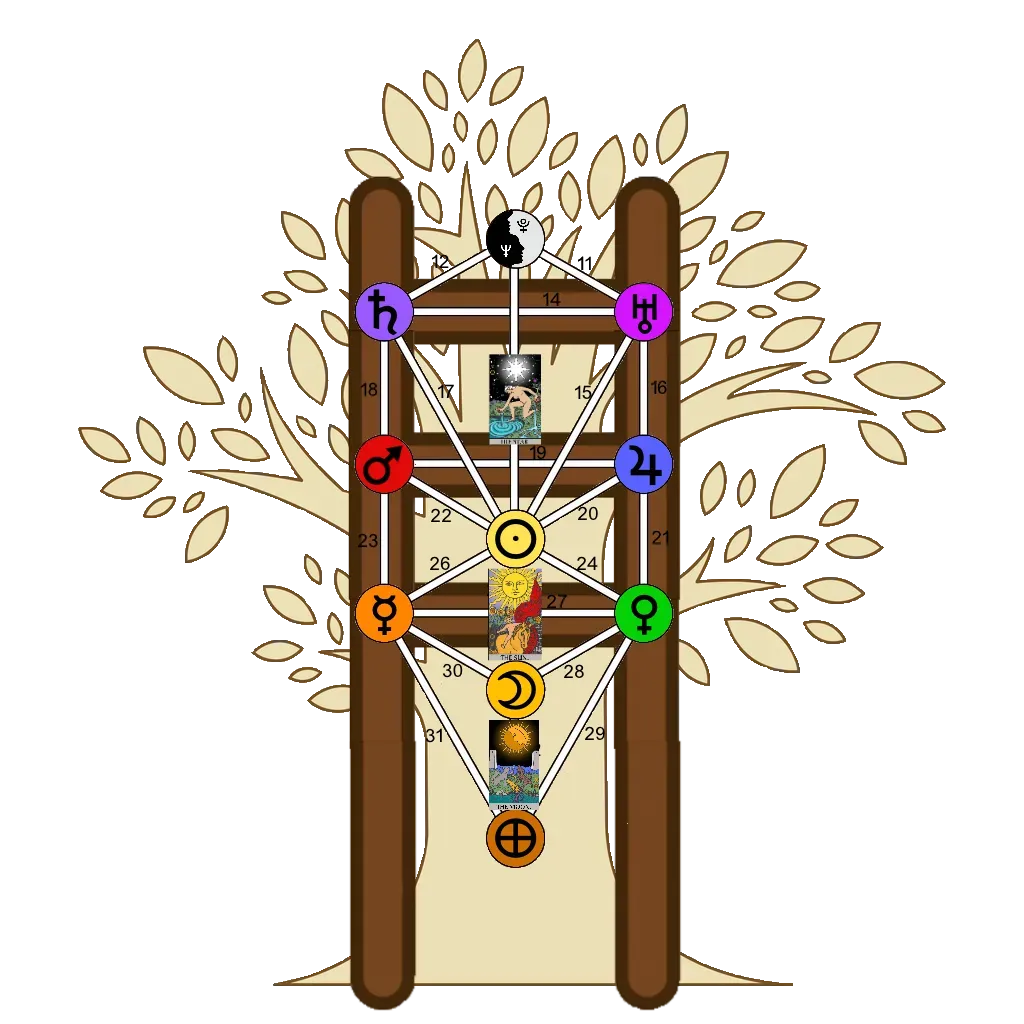
The ascent up the center of the Tree is the straight route consciousness takes, as in stages it grows brighter in response to experience.
The Path of The Moon is the 32nd Path (between the Earth and the Moon), Childhood. The physical body (Earth) connects with memories & feelings (Moon).
The Path of The Sun is the 25th Path (between the Moon and the Sun), aka the Yellow Brick Road. Adulthood. Memories & feelings (Moon) connect with individual awareness (Sun).
The Path of The Star is the 13th Path (between the Sun and Neptune/Pluto), Elderhood.
The Sun (Part 1), or Adolescence
on the 2nd stage of the Ascent, the 25th Path (between the Moon and the Sun), aka the Yellow Brick Road.
Memories & feelings (Moon) connect with individual awareness (Sun).
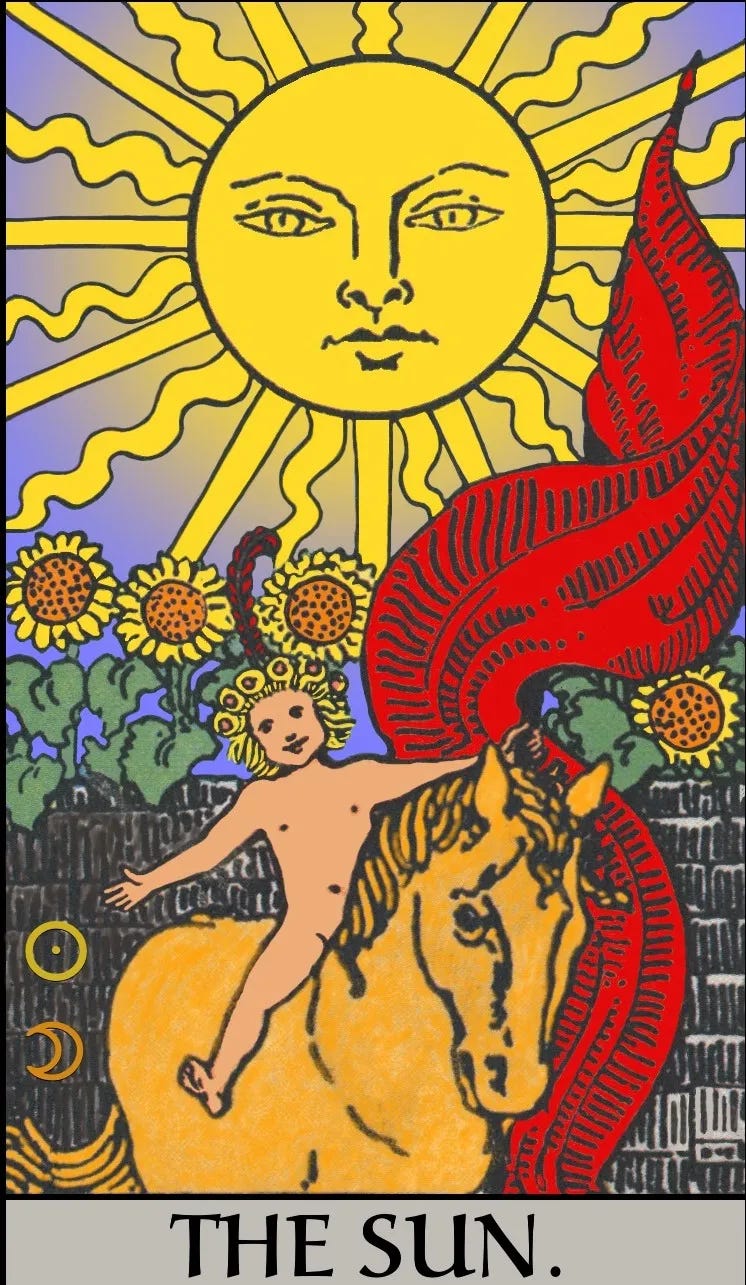
In full daylight, an amber mare walks unharnessed within the boundary of a stone wall. She is the Lunar unconscious mind, programmed with memories and habits, and grounded in Earthly reality.
Riding the mare is a smiling child, hands free and perfectly balanced on her bare back. He is the Solar conscious mind, supported by the animal beneath him, and free to play in the open sunshine. His nakedness signifies his innocence; his appearance as a child symbolizes the perpetually youthful, playful attitude of a well-balanced mature adult.
A large red banner flows alongside horse and rider, in celebration of the powerful life force flowing through them both. The red feather on the child’s head is the same symbol of active mental development that we see on the head of that novice thinker, The Fool.
Four proud yellow sunflowers smile on the child from the wall, suggesting the healthy and supportive function of all Four Elements. The child wears a crown of smaller yellow flowers, tokens of blessings and happiness.
The great yellow Sun, sustainer of life and noble hero, shines brightly and warms everything below. The Sun’s conscious awareness is shown in his open eyes. The only question one might ask is, who is seeing through those eyes?
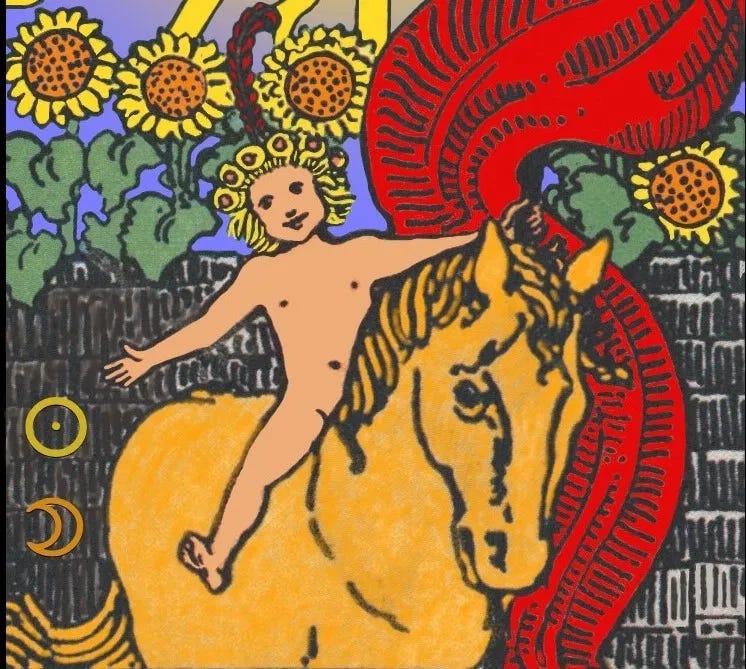
To an adolescent, the Sun may seem to be someone else whom he admires deeply, and whose approval he craves. Hero worship is typical of young people in this stage of development, because they have yet to discover the hero in themselves. When they feel appreciated, their self-image may be sunlit like the lower half of the Sun card, but it doesn’t include the Sun, whose potential power within themselves they are projecting on, and seeing in, their “wonderful” hero.
The adolescent is venturing upward in consciousness on the Tree, making his way to the adult independence and mental maturity signified by the Sun. But he’s starting out with the childhood dependency of the Moon, including all of its emotional sensitivity and programming, which is a formidable challenge to the development of objectivity.
The diagonal paths connected with the Moon feed into our internal, subjective world of feelings, impressing our memory with “good” or “bad” feelings about our experiences (follow the links to read more about these paths):
The Path of the Guardian, a path of deterrents, where prohibitions, fears, and associations with bad memories serve to protect us from danger and trouble.
The Path of the Lovers, a path of incentives, where encouragement, hope, and associations with good memories serve as guides to success and fulfillment.
By the time of adolescence, a young person’s Lunar self is usually well fortified with memories and habits, and is strong. His impatience with life under family authority is growing as fast as his eagerness for autonomy. He tries to push off from his Watery Lunar childhood and become his own person, but until he is ready to claim real independence, he continues to feel its influence and his own inadequacy. For most, it’s a difficult and frustrating time through which to cope.
Though he is trying to free himself from dependency on family, the adolescent is still used to looking up to some authority for security. Solution? Find an outside ‘hero’ (a teacher, older friend, celebrity, etc.) to idolize and emulate, and bask Moon-like in that person’s Sunlight while exploring his personal abilities and options.
The adolescent’s ongoing immersion in Lunar emotions brings all kinds of exaggerated excitement and drama to his explorations, along with the experiences he needs for mental growth.
An attachment to a heroic role model is no exception, and is a good thing for a while. The adolescent resonates with something in that person that is very like something important in himself that’s awakening, and he learns. He may feel that he needs that person as a child needs a parent, and intends to become just like that person. That might be a comforting plan. But eventually it will have to be abandoned, because life doesn’t work that way.
"Life is what happens when you’re busy making other plans". — John Lennon
It can’t be scripted in advance, but can only be improvised.
"Life is a guy trying to play a violin solo in public, while learning the music and his instrument at the same time." ~ Joseph Campbell
Although we may find clues to our destiny in other people’s examples, no plan to follow in other footsteps can possibly work for us. We have to find our way on our own, which, to an adolescent not well acquainted with his own intuition, is a scary prospect.
“If you can see your path laid out in front of you step by step, you know it's not your path. Your own path you make with every step you take. That's why it's your path.” ― Joseph Campbell
Why is that? Why wouldn’t an adult life that works perfectly well for one person work just as well for another? Because each fully-developed adult is unique, with a destiny that can be satisfied only by following his own intuition as his potential unfolds.
“What each must seek in his life never was on land or sea. It is something out of his own unique potentiality for experience, something that never has been and never could have been experienced by anyone else.” ― Joseph Campbell
How can we possibly plan for that? We can’t. None of us can.
“If the path before you is clear, you're probably on someone else's.” ― Joseph Campbell
“You enter the forest at the darkest point, where there is no path. Where there is a way or path, it is someone else's path. You are not on your own path. If you follow someone else's way, you are not going to realize your potential.” ― Joseph Campbell, The Hero's Journey: Joseph Campbell on His Life & Work
The Path of The Sun is about adult mental capability. The challenge on this path is to let go of juvenile insecurities that inhibit spontaneous individual awareness and intuition, and learn to heed that intuition. For success there can, and should, be a tentative direction, but there can’t be any rigid plan.
The position of the adolescent on this path is similar to that of a child transitioning from a tricycle to a two-wheeler. He starts with the support of training wheels on the bike, and there’s an awkward period of dependency on them until a new inner sense of balance kicks in and it’s time to remove the extra wheels. C.G. Jung calls the psychological equivalent individuation.
"It is the individual's task to differentiate himself from all the others and stand on his own feet. All collective identities . . . interfere with the fulfillment of this task. Such collective identities are crutches for the lame, shields for the timid, beds for the lazy, nurseries for the irresponsible. . . ." —Carl Jung
"Individuation is to divest the self of false wrappings." — Carl Jung
Campbell compares borrowed identities/roles to “masks” that an adult must be able to set aside in favor of authenticity.
“To become—in Jung’s terms—individuated, to live as a released individual, one has to know how and when to put on and to put off the masks of one’s various life roles. ‘When in Rome, do as the Romans do,’ and when at home, do not keep on the mask of the role you play in the Senate chamber. But this, finally, is not easy, since some of the masks cut deep. They include judgment and moral values. They include one’s pride, ambition, and achievement. They include one’s infatuations. It is a common thing to be overly impressed by and attached to masks, either some mask of one’s own or the mana-masks of others. The work of individuation, however, demands that one should not be compulsively affected in this way. The aim of individuation requires that one should find and then learn to live out of one’s own center, in control of one’s for and against. And this cannot be achieved by enacting and responding to any general masquerade of fixed roles.” ― Joseph Campbell, Myths to Live By
And so in adolescence, each of us begins the personal process of individuation. When adolescence ends, we may still have years of self-discovery ahead of us, but we’ve made a significant beginning. At that point, we’re ready for autonomy. We know ourselves as individuals well enough to stand ‘on our own two feet’, free of crippling juvenile insecurities, and capable of navagation through life on our own intuition.
In divination, I read The Sun as conscious, clear thinking. Intuitive engagement with life on an adult level. Thinking for oneself. Authenticity.
If it’s reversed, I read it as partly conscious, unclear thinking, distracted or distorted by emotions or faulty assumptions.
Music for the Path of the Sun (Part 1)
The years of adolescence are years of fun, but also of pain and frustration. We make mistakes and learn from them on our way to self-discovery. The music below expresses something of this stage of life:
When I Grow Up (to Be a Man)
Brutal
You Gotta Be
Beauty School Dropout (from Grease)
Corner of the Sky
Make Your Own Kind of Music

The Leo Files
More to enjoy whenever the Sun is in Leo
The Mystical Tree
A Table of Contents
See all the parts of the Ladder